
Feel the vibe. Sense the attraction. Ride the wave. Go with the flow.
How often do we describe our lives through the language of energy, movement and connection?
We feel drawn toward something—or pulled away from it. We find our path and follow it. Sometimes everything seems to flow, as though life itself resonates within us.
These are questions that have lived with me for many years.
Life is not always harmonious. Sometimes the rhythm changes. We feel out of tune, disconnected or as though the natural ease of life is missing. We might describe this metaphorically as “dis-ease”—a loss of ease within ourselves.
Yet although we describe life through music, sound and frequency, we rarely consider whether these same principles might help bring us back into balance.
We look at people, places and ideas outside ourselves and ask, “Does this resonate with me?”
When we look within, we seek harmony.
The Hebrew language offers another dimension to this idea. Each Hebrew letter carries a numerical value, a sound and a meaning. When letters come together, a word becomes a relationship among number, vibration, sound and intention.
From this perspective, the Sacred Texts can become more than a collection of words—if we allow them to.
When we do more than read their words—when we speak them, hear them and allow their meaning to shape how we live—the words become active within us. Even the words we speak and the sounds we make can become part of how we heal, helping bring us back toward harmony in our spiritual, emotional, mental and physical being.
We may not ordinarily think of sound, vibration or frequency as having therapeutic properties, yet we already use carefully selected forms of energy in healthcare. Ultrasound uses sound waves, while lasers and red-light therapies use specific wavelengths of light.
These technologies work in different ways, but they remind us that sound, light, energy and frequency can interact with the body.
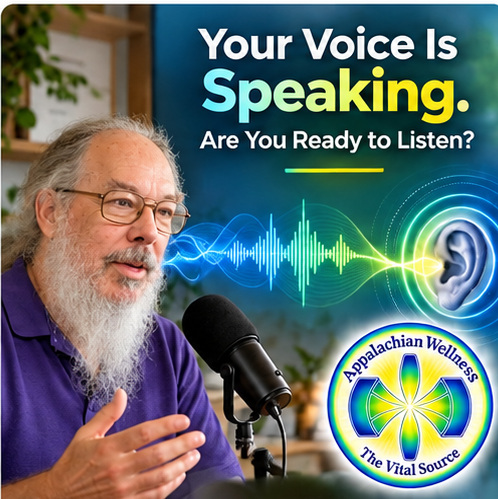
So why shouldn’t we consider that our own voice might be telling us something—might actually be speaking to us?
Our voice carries more than our words. It carries changes in tone, rhythm, emphasis and expression. It may reflect something about what we are experiencing at that moment.
And if we learn to listen, perhaps we can find the song that helps bring us back.
The Hebrew word teshuvah—תְּשׁוּבָה is often translated as repentance, but its deeper meaning is return.
Return to balance. Return to harmony. Return to what is true. Return to ourselves.
Sound and vibration, resonance and harmony may help guide that return—a return toward greater wholeness in body, mind and spirit, health and well-being.
This is part of what I explore through bioresonant biofeedback: listening for patterns within the voice and creating personalized frequencies intended to support relaxation, awareness and balance.
Your voice may already be speaking to you. Are you ready to listen?